“We’re here, live in downtown Fort Worth.”
Eric kept his voice level, practiced, almost calm. Behind him, the street burned.
Storefront windows were shattered, their interiors picked clean. Cars sat abandoned in the road, some still smoldering, others riddled with bullet holes. Bodies lay where they had fallen—some covered, most not. Police sirens wailed somewhere in the distance, fading in and out like a warped signal.
“Folks, if you’re watching from home, stay inside. Lock your doors. We still don’t know how this violence started, or why it’s spreading so quickly—but we do know it isn’t stopping.”
The words came easily. Eric had said versions of them for weeks now. A crack split the air. Then another. Jake flinched behind the camera. Eric didn’t.
Gunfire erupted a block away, a chaotic spray of shots tearing through the street. Bullets zinged past the van, snapping against brick and glass. One punched clean through the side panel with a deafening clang.
The driver was violently jolted, then slumped forward.
“Cut the feed,” Eric said sharply.
Blood spattered the driver’s-side window.
For a moment, neither Eric nor Jake spoke. The only sound was the gunfire outside and the engine idling uselessly.
“Our driver’s been shot,” Jake spoke as though he may be next but Eric was already moving into action. It was almost like he was getting used to the raging violence rather than flinching.
They both dragged the driver into the passenger seat as another volley of shots echoed down the street. An ambulance screeched around the corner, lights flashing. Eric stepped into the open, waving his arms.
“Over here!” he shouted. “We need help!”
The ambulance slowed—just for a second. Then gunfire struck its side. The driver didn’t hesitate. Tires screamed as the ambulance swerved and sped past them, disappearing down the street.
Eric watched it go, jaw tight.
“They left,” Jake said, disbelief cracking his voice.
“They didn’t leave,” Eric replied. “They survived.”
He slid behind the wheel.
“Hold on,” he said. “We’re going to the hospital.”
The emergency room was already overflowing. Patients lined the halls, sprawled on gurneys, on chairs, on the floor. Nurses moved quickly, stepping over bloodied limbs, shouting instructions that no one seemed to hear. A man screamed somewhere behind a curtain. No one came.
Jake stood frozen, camera hanging uselessly at his side. Eric took it all in with a distant calm. He’d seen worse. Or maybe it just felt that way now. A nurse rushed past them, scanning faces.
“Life-threatening only,” she shouted. “If they’re slightly injured, they wait.”
A woman clutched a child to her chest, rocking back and forth. The child wasn’t crying although he probably should be. Eric couldn’t tell if it was the boy’s blood or his moms. They both turned to look but Eric looked away first.
Security caught up with them near the intake doors.
“You can’t be in here,” one of them snapped, already reaching for Jake’s camera.
Eric held up his press badge. “We’re with DFW News. We were just inside—”
“Not anymore,” the guard said. “You’re blocking staff.”
Behind them, a stretcher rattled past, its wheels squealing. A man coughed wetly, blood bubbling at the corner of his mouth. No one slowed down. Eric adjusted his jacket.
“Jake,” he said, calm and firm. “Camera up.”
Jake hesitated. “Eric—”
“Now.”
The red light blinked on. Eric turned, framing the chaos behind him just as security pushed them back toward the exit.
“Tonight marks the fifth consecutive week of national emergencies,” Eric said into the lens. “Hospitals across the country are operating beyond capacity, forcing doctors and nurses to make impossible decisions—”
A hand grabbed his shoulder and shoved him hard. The feed cut. Outside, the air felt colder. Jake lowered the camera, face pale. “We shouldn’t have done that.”
Eric paused among the craziness going on around him and checked his phone. Clips were already uploading. Views climbing. Comments scrolling too fast to read. The news headquarters quickly sent out the breaking news leaving viewers on edge since their driver was shot.
“We got what we needed,” Eric said.
He didn’t sound proud. He didn’t sound ashamed either. The trauma of the day lay hidden so much that Eric didn’t remember the drive home. His apartment greeted him with silence—thick, unnatural silence. No sirens. No shouting. Just the hum of the refrigerator and the faint buzz of streetlights leaking through the blinds.
He kicked off his shoes and collapsed onto the couch, jacket still on. For the first time in two days, he closed his eyes. The phone buzzed. Once. Then again. Eric groaned and rolled onto his side. The phone vibrated off the coffee table and skidded across the wooden floor. He stared at it for a long moment before picking it up.
NASA. NASA. NASA.
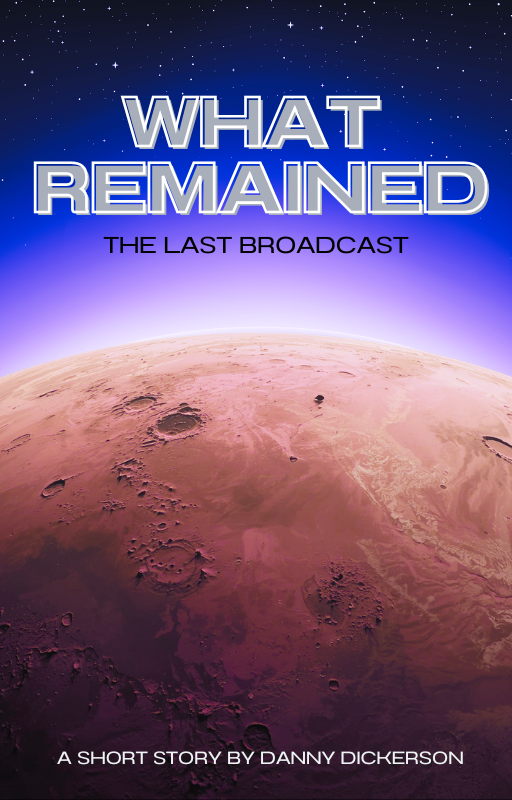
Notifications stacked on top of each other—alerts, headlines, breaking banners. He turned on the television. Every channel showed the same thing. A rover crawled across a red horizon, its camera sweeping slowly over sand that didn’t look quite right.
Eric rubbed his eyes.
“—initial scans suggest artificial geometry beneath the surface,” a voice said. “At this time, NASA is urging caution and restraint—”
Eric muted the TV blocking the noise.
Artificial geometry.
He leaned forward, elbows on his knees, watching the rover’s feed in silence as faint lines emerged beneath the sand—angles too straight, patterns too deliberate. Not by chance, he told himself.
The Archaeology had to be a part of something big, or something forgotten. The phone buzzed again. Eric didn’t answer it. He just lay down and soon within deep sleep.
By morning, the riots had quieted—not ended, just dulled, like a fire starved of oxygen. Eric was back in the newsroom before anyone asked him to be. Every screen glowed red.
NASA’s feed dominated the wall monitors: the rover inching forward, its mechanical arm brushing away fine layers of Martian dust. With each careful sweep, more of the buried structure revealed itself.
Straight lines.
Right angles.
Eric crossed his arms.
“Could be a trick of erosion,” one scientist said on-screen. “Mars has a long geological history. Unusual formations aren’t unprecedented.”
Another expert shook her head. “These aren’t natural. The symmetry alone—”
The feed zoomed in. A corner emerged. Clean. Deliberate. Eric felt a flicker of interest, nothing more. He stepped in front of the camera.
“What we’re seeing may be the greatest archaeological discovery in human history,” he said. “Not evidence of life—but evidence of intelligence. A civilization lost long before recorded history.”
Phones rang behind him. Producers whispered urgently. Eric kept talking.
“If confirmed, this could rewrite our understanding of technological development—not just on Earth, but across the solar system.”
The first translation hit just after noon. Eric was mid-sentence when a producer touched his arm.
“Change of script,” she said quietly. “Now.”
The monitor behind him shifted. A still image filled the screen: markings etched into stone, shallow but unmistakably intentional. Symbols carved in careful lines, clustered in repeating patterns.
“This is a section of the newly uncovered interior wall,” Eric said, reading as the words updated in real time. “Researchers believe these markings may represent a form of written language.”
He glanced off-camera.
“What language?”
The answer appeared at the bottom of the screen. ARAMAIC. The studio went quiet. Eric felt his mouth dry and his stomach drop.
“That’s… unlikely,” he said carefully. “Early analysis suggests similarities to Aramaic, an ancient Earth language. Experts caution this may be coincidental.”
Another alert slid into view. HEBREW CONFIRMED. Gasps rippled through the room as some of the legible words were translated into “The last shall be seen but not known.” Eric straightened as more came through— “The Watchers at the Gate claiming that the crown was heavier than it appeared.”
“Let’s be clear,” he said, voice firmer now. “This does not suggest a religious connection. Language evolves. Symbols repeat. What we may be seeing is convergence—independent development following similar cognitive patterns.”
The words came faster. Sharper. “If anything,” Eric continued, “this discovery challenges the idea of divine origin. It suggests humanity’s myths may be echoes of something far older— even technology mistaken for gods.”
He paused just for a fraction of a second. Behind him, the camera lingered on the markings. They didn’t look mistaken. Eric forced a small, confident smile and continued the broadcast.
The rover reached the cave entrance late in the afternoon. Its camera adjusted as it crossed the threshold, light spilling across stone walls that hadn’t seen illumination in hundreds or perhaps thousands of years.
The first drawing appeared almost immediately. A tall figure etched into the rock, its proportions wrong—too long, too narrow. Lines radiated from its head, not quite horns, not quite light. Smaller figures clustered below it, their arms raised.
Eric leaned closer to the monitor.
“These appear to be pictographs,” he said. “Likely symbolic representations of—”
Another image replaced the first. More figures. More scenes. Beings descending from above. Structures aligned beneath stars. Symbols repeated again and again beside the figures, carefully drawn.
A caption appeared beneath the feed.
IYR — TRANSLATED: ‘THE WATCHFUL ONES’
A chill crawled up Eric’s spine before he could stop it.
“Watcher is a common mythological motif,” he said quickly. “Found across multiple ancient cultures. What we’re seeing here may be humanity projecting familiar narratives onto—”
He stopped. The next image showed a diagram. Pyramid-like structures etched into stone, their angles precise. Lines extended from their peaks, pointing toward constellations.
One alignment was highlighted— Sirius star system. The “Dogon” was imprinted near it. The Dogon are a tribe living in Mali, Africa.
Eric was trying to remain centered and calm as he processed this information and read it aloud. According to the myth as recorded, the Dogon say that sky-beings came from the Sirius system and shared cosmological and cultural knowledge with their people.
“This is unbelievable,” Jake said quietly from behind the camera as he realized these findings could implicate not only life extended beyond earth but also religious factors too.
The world didn’t wait for clarification.
By evening, crowds gathered outside churches. Candles flickered in the streets. Some people prayed. Others shouted. A few simply stared upward, as if expecting the sky to answer.
Eric stayed on air. The rover’s camera panned slowly across another section of the cave wall. This drawing was different. A massive vessel dominated the frame, its shape unmistakable. Supported by figures beneath it.
The room went silent and a translation followed.
“THE SON OF CAIN. GRANDFATHER OF NOAH.”
Eric tensed but remained as his deadened composure to the world.
“This appears to be another mythological reference,” he said, but his voice lacked its earlier sharpness. “An allegorical—”
He paused as his phone buzzed. Then buzzed again. Behind the camera there was alerts flooded in as mass hysteria was beginning to set in outside. Some people newly believing in Christianity and others questioning the whole thing.
Eric glanced at the live feed of the cave wall. The drawing didn’t look allegorical. Outside, sirens blaring. The panic was getting worse. He could just feel it. Eric turned back to the camera.
“We are continuing to verify these findings,” he said carefully. “Viewers are urged to remain calm.”
For the first time, he wasn’t sure he believed his own words. Then, every channel cut at once. The alert tone pierced through phones, televisions, laptops—one long, shrill note that demanded attention before silencing itself.
The president appeared on-screen, standing at a podium flanked by flags that suddenly felt ceremonial rather than reassuring.
“My fellow Americans,” he began, voice steady, practiced. “And citizens of the world.”
Eric watched from the anchor desk, hands folded in front of him. The newsroom had gone unnaturally still.
“Today’s discoveries on Mars represent an unprecedented moment in human history,” the president continued. “In light of growing speculation, I want to be clear about what we know—and what we do not.”
He paused and glanced at those gathered around before looking back to the camera.
“The written languages discovered on Mars were NOT copied from Earth.”
The words landed heavily.
“Earth,” the president said, carefully, “copied them.”
A hushed voices rippled through the studio.
“These findings do not suggest coincidence or contamination,” the president went on. “They suggest inheritance.”
Eric felt his throat tighten.
“We ask the public to remain calm while further analysis continues,” the president concluded. “There is no immediate danger,” he added as he displayed a slightly mischievous grin before the feed cut.
Eric leaned toward the camera.
“Let’s take a breath,” he said. “This statement doesn’t imply any reason to be concerned or necessarily any religious validation. Old and faded cave drawings as well as language can be inherited culturally—”
He stopped.
The words sounded thin.
NASA resumed the rover feed without commentary. The machine emerged from the cave slowly, its camera adjusting to the open light. A hill rose ahead and near it were words etched into a large stone.
As the rover climbed, the world watched as the words were translated in real-time. The translation came back as “Golgotha.” A further explanation followed as Eric read the screen prompt which defined it’s meaning— something that Eric was hesitant to say.
“Golgotha was translated from Aramaic, and its meaning is known as “the place of the skull.” It is the site where Jesus Christ was crucified as mentioned in The Bible.”
Eric couldn’t believe the words he had just aloud. Before he could have a chance to fully absorb it, the live footage of the rover was about to reveal something else even more shocking.
At the summit, three vertical shapes came into view.
Eric felt the room empty of sound.
Three wooden crosses stood against the Martian sky, weathered but intact. On the left and right, skeletal remains hung slumped, ribs exposed, skulls tilted forward in eternal surrender.
The center cross was bare.
No body.
No bones.
The camera lowered.
At the base of the hill, words were carved into the stone—deep, deliberate, untouched by time and translated as:
“I am the good shepherd. The good shepherd lays down his life for the sheep.”
—John 10:11
No one in the studio spoke. Eric felt something cold settle in his chest. For believers, the implications were impossible. For skeptics, they were worse. The camera lingered and then pulled back.
Every screen went live again.
The president’s face appeared, calm, composed, almost amused. There were no notes this time. No teleprompter.
“My fellow citizens,” he began, voice measured, steady. “Mars was once a habitable planet. And what has been revealed to us is not the beginning of humanity—it is its judgment.”
The words hung in the room. Eric’s hands trembled slightly on the desk.
“The cycle has been completed,” the president continued, his eyes glinting with a strange intensity. “Death, resurrection, salvation—already accomplished. And yet…”
He paused, letting the silence stretch.
“...the taking or rapture has occurred as well.”
A ripple of confusion spread across studios and living rooms worldwide.
“What about the rapture?” The president asked, his smile faint but unmistakably there. The question was rhetorical. The answer was clear: too late.
Eric felt a chill settle over him. For the first time, he understood that the world had passed him by. That what remained was not survival, not judgment day, not apocalypse in fire or brimstone.
It was continuity.
Relentless. Unstoppable. Inescapable.
The studio was frozen.
Cameras caught every face—technicians, producers, interns—each silently staring at the screen. Eric leaned back in his chair, finally letting the weight of it settle. The rover feed still streamed, the empty center cross staring back at the void. No words came to him. He didn’t reach for his microphone. The world had already moved past disbelief. He understood, fully, for the first time.
Hell was not fire.
It was continuity.
It was what remained.